Webinars

Learn how analytics can drive better decision-making for you and your institution.

Upcoming Webinars

Keeping Students on Track Term-to-Term

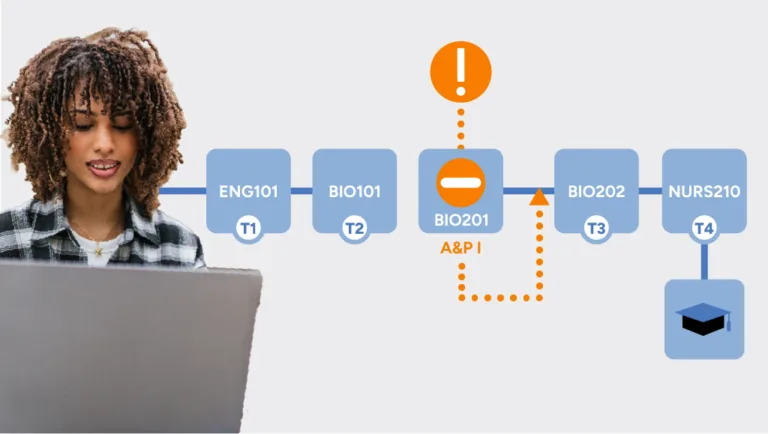
Meeting with an advisor, registering on time, passing every course — none of it guarantees a clear path forward if the one class a student needs next isn’t offered until spring, or only runs at 8 a.m. when they work mornings. These aren’t edge cases. They’re structural: a handful of bottleneck courses that dozens of students all need at once, a sequence that forces a full year of waiting if a student misses one step, or a schedule built around last year’s demand instead of who’s actually enrolled now.

Ensuring Credentials Lead to Real Opportunity

Too often, colleges only find out whether that belief was justified after the fact – once a student has already finished a program that didn’t lead to steady work, or led to one indistinguishable from what they had before. Federal attention on program-level outcomes and short-term Pell expansion means that gap is about to get a lot harder to leave unexamined.

Break the Historical Patterns that Cause Uneven Results

Those performance gaps rarely come from one moment. They show up at specific breakpoints in the student journey: the first registration and course load decision, early momentum in gateway courses, access to support at the right time, repeating or withdrawing from key requirements, or losing time because the next required course isn’t available when life allows.

Building a Culture That Scales

The problem is almost never a lack of good practice somewhere in the building. It’s that the practice stays exactly where it started – it doesn’t survive the person who built it leaving, a new priority landing on the cabinet’s desk, or the natural fatigue that sets in once the first few wins stop feeling new.

On-Demand Webinars

A missed assignment. A course quietly going sideways. A work schedule that no longer leaves room for class. A request for help that never turned into real support. Individually, none of these look urgent – together, and caught early enough, they’re usually the clearest warning a college will get.
Students have more choices – and more questions – than ever before. In a shrinking pipeline, enrollment isn’t guaranteed. Learn how community colleges are using data to reach high-potential students, align outreach with career opportunity, and position themselves as the smartest path to economic and social mobility.
Chattanooga State leaders share how a campus-wide culture of data and collaboration improves student momentum, completion, and equity—offering practical lessons peer colleges can apply.
Disconnected systems and unreliable data hold institutions back. See how colleges are building modern data infrastructure to unify insights, guide faster decisions, and drive real impact - from increased completions to stronger funding returns and better workforce alignment.
Not all completions lead to careers - and students are rightfully asking what their credential is worth. Discover how institutions are aligning academic pathways with industry-recognized credentials, tracking post-graduation outcomes, and making sure students leave with more than a diploma - they leave with a future.
Staying enrolled is no longer enough - students must keep moving toward credentials that lead somewhere. Explore how colleges are using early momentum metrics to track progress, identify where students get stuck, and ensure every learner stays on a path to meaningful outcomes and mobility.
What if every student who’s earned a credential actually received the recognition they deserve? In this session, Patrick Sanger will share effective strategies Alvin Community College uses to identify those often overlooked achievements and help students receive the degrees and certificates they’ve earned. Discover how recognizing these credentials not only opens meaningful opportunities for students but also strengthens the college’s performance-based funding and resources.
Students have more choices – and more questions – than ever before. In a shrinking pipeline, enrollment isn’t guaranteed. Learn how community colleges are using data to reach high-potential students, align outreach with career opportunity, and position themselves as the smartest path to economic and social mobility.
What happens when data isn’t just collected - but used to drive action, improve outcomes, and empower every department? At Collin College, IR didn’t just build dashboards - they built a culture. Learn how they unlocked data across campus, equipped users to make better decisions, and turned insight into measurable impact.
Discover how City Colleges of Chicago transformed campus-wide reporting by building self-service dashboards tailored to real users. Learn how custom SQL, stakeholder feedback, and user-friendly design helped drive faster decisions, deeper trust, and stronger engagement across departments.
Colleges can no longer rely on race or gender to guide student success goals. This session explores how the Economic Hardship Index offers a powerful, compliant alternative - enabling institutions to target support, close performance gaps, and drive equitable outcomes.
Growing data demands stretched the IR team at College of the Siskiyous. By automating reports and enabling real-time analysis, they’ve expanded capacity without adding staff - uncovering performance gaps, streamlining program review, and preparing to capture untapped SCFF funding.
Discover how Southeast Community College streamlined accreditation reporting and improved institutional outcomes by integrating ZogoTech and Nuventive - creating a sustainable, data-informed accreditation process that drives continuous improvement.
Join an interactive panel to discover how colleges are replacing manual data tasks with improved accessibility, empowering faculty and staff with actionable insights for strategic analysis and enhanced student success.
Central Arizona College adopted the 4 Disciplines of Execution (4DX) framework to turn institutional goals into measurable actions - leading to improved student persistence, campus-wide accountability, and meaningful progress on student outcomes.
Learn how Institutional Research leaders are moving beyond traditional reports to uncover hidden trends, proactively address performance gaps, and deliver actionable insights that measurably improve student outcomes.
Manual degree audits leave thousands of credentials unawarded. North Central Texas College automated the process - identifying over 700 missed completions in a single year and unlocking $1.85 million in performance-based funding.
Traditional data sources often miss the full picture of student outcomes. Dallas College's Research Institute integrates unconventional datasets to provide a comprehensive view of student success, enhancing both academic and workforce outcomes.
Advisors and planners needed earlier signals to guide students and shape enrollment. By implementing predictive analytics, Johnson County Community College now forecasts enrollment more accurately, identifies at-risk students sooner, and delivers timely interventions that improve outcomes.
Disjointed planning and reporting processes hindered effective decision-making. By integrating ZogoTech's analytics with Nuventive's planning platform, institutions can unify data insights with strategic objectives - streamlining improvement initiatives and enhancing student outcomes.
Focusing solely on the 'Enrollment Cliff' overlooks other critical challenges. Southeast Community College uses data analytics to identify and address multiple institutional 'cliffs,' enhancing resilience and driving student success.
Manual tracking left Alvin Community College blind to key student milestones. By shifting to real-time analytics, they identified over 1,200 students off track or near completion - streamlining advising, boosting scheduling efficiency, and accelerating credential attainment.
Traditional assessment methods burdened faculty with manual data aggregation and lacked flexibility. Lee College introduced a streamlined data model that automates processing, accommodates diverse programs, and empowers faculty to focus on enhancing educational quality.
Faced with a clunky legacy system, Collin College built a centralized web portal that simplified program review, improved access to key documents, and strengthened compliance workflows.
Manual reviews overlooked thousands of eligible completions. Colleges across Texas are now using data to uncover unawarded and near-complete credentials - recovering millions in funding under House Bill 8 and driving higher completion rates.
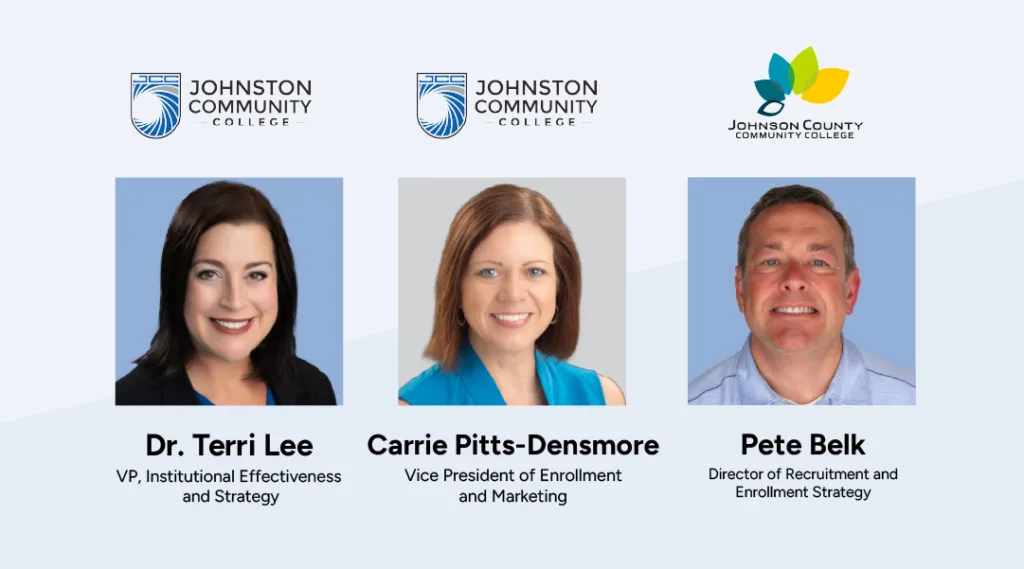
Three colleges - Chattanooga State, Central Arizona College, and Johnson County Community College - share how building a unified data culture accelerated enrollment growth, improved retention, and amplified student success.
Enrollment declines felt inevitable. Brazosport College challenged that narrative - leveraging data-driven strategies to achieve 2% and 5% enrollment increases over 2 years, effectively reversing the downward trend.
Faculty lacked timely insights to support students effectively. Grayson College addressed this by integrating LMS data into advising dashboards, fostering proactive outreach, enhancing accountability, and cultivating a culture of continuous improvement to boost student persistence.