
White papers for the people who run community colleges.

17 pages
15-min read
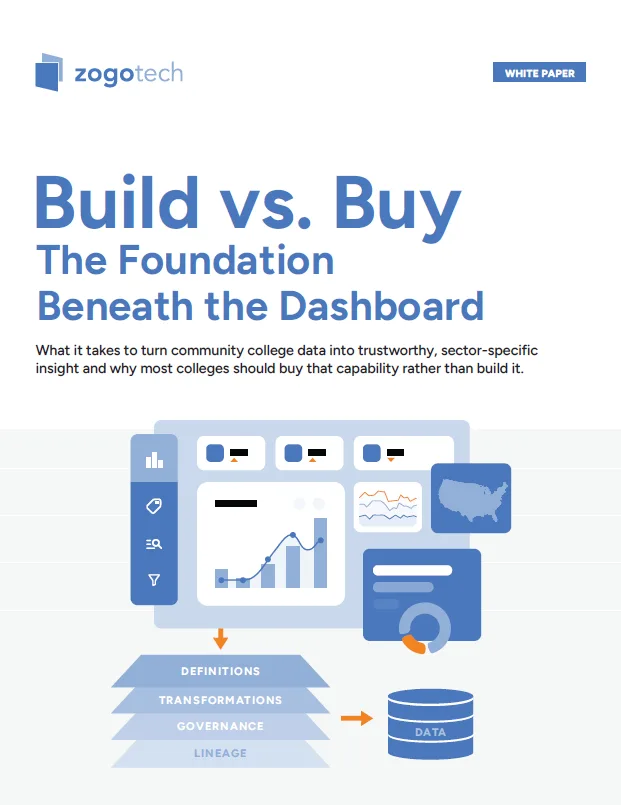
The dashboard was never the hard part. Before your college commits two years and $400K a year to building its own data warehouse, see what it actually costs.

20 pages
25-min read
Most colleges are betting AI will clean up their data. It won’t. This is what has to be true about your data first – and why the colleges that get it right will pull away from the ones that don’t.

10 pages
10-min read
Only half of today’s young adults out-earn their parents – down from more than 90% a generation ago. Eleven community college presidents refuse to accept that, and they’re showing their work.
16 pages
15-min read
Hand a room of community college presidents a blank slate and take away every constraint. What they said they’d do – and what’s stopping them – is the most honest picture of the sector you’ll read this year.
Firms that implement data warehouses professionally quote $200,000 to $1 million or more for a medium-to-advanced build on a three-to-twelve-month timeline - and that buys a general-purpose warehouse before any community college logic is added. Built in-house, the cost moves onto payroll: two to three data engineers at the U.S. median wage of $135,980 run upward of $400,000 a year with benefits and overhead, every year. Two years of that equals the consultants' quote, paid in salaries. ZogoTech's Build vs. Buy white paper documents the full cost with independent sources, including the one expense no budget can recover: the history a college never captured.
For most community colleges, buy the foundation and build on top of it. Three facts drive that conclusion: the average two-year college's institutional research office is 2.9 people, the data professionals who would build a warehouse stay an average of 1.7 years, and point-in-time history cannot be reconstructed after the fact - many cloud systems now retain source data for as little as thirty days. The exception is a large district with a dedicated data-engineering team, where the real question becomes opportunity cost. Build vs. Buy: The Foundation Beneath the Dashboard walks through the decision layer by layer.
Because the data beneath it disagrees with itself. On a typical campus, "enrolled" is defined four ways: the registrar counts registrations, financial aid counts students who have paid, state reporting counts at census, and institutional research uses a fourth definition for longitudinal analysis. AI trained across all four learns noise and returns confident answers that are wrong, at scale. Embedding AI inside each system doesn't fix it - an AI in a silo is just a faster silo. The AI-Ready Institution explains why community college data is especially vulnerable and how to fix the foundation first.
A governed data foundation that meets six conditions: accuracy, completeness, integration, consistency, governance, and timeliness. The AI-Ready Institution frames these as a hierarchy - collect, transform, govern, analyze, and only then predict and act. Predictive analytics, agentic workflows, and natural-language data access sit at the top; attempting them on a fragmented foundation produces failure, or the illusion of results that collapses under scrutiny. The paper includes a practical roadmap that begins with an honest data assessment before any AI contract is signed.
A single source of truth is one governed data foundation in which every system's data is unified, every key measure - enrolled, retained, completed, returned - has one documented definition, and daily snapshots preserve history for true year-over-year comparison. It matters because it ends the "whose numbers are right" debate before a board meeting and moves leaders to "what do we do next." Presidents in ZogoTech's Rebuilding the American Dream series named it the fifth of their five strategic shifts, and Build vs. Buy explains what it takes to construct and maintain one.
Eleven community college presidents and senior leaders identified five: redefine success around mobility and family-sustaining wages; turn enrollment from a season into a long-term relationship; guarantee belonging through designed webs of care; align every pathway with work, transfer, and rising wages; and build one source of truth that everyone can act on. The urgency is generational - about 90 percent of children born in 1940 went on to out-earn their parents, versus roughly 50 percent of those born in 1980. Rebuilding the American Dream for Today's Learners details each shift with leadership moves a college can start inside a typical budget.
At a CEO-only Think Tank at the 2025 AACC Annual Conference, more than 40 presidents and chancellors proposed an AI assistant assigned to every student from enrollment to completion, eliminating the Carnegie Unit in favor of mastery-based pathways, lifelong digital learning portfolios that follow students into their careers, and a national database to stop transfer students from losing credit. Their shared caveat: none of it works without accurate, consistent, AI-ready data first. Data-Driven Breakthroughs captures the ideas, the votes, and the barriers holding most colleges back.