

Enrollment growth

More returning stop-out students

Additional state aid

Students re-enrolled

Semesters of double-digit growth
Johnston Community College (JCC) is a public community college in Smithfield, North Carolina, serving Johnston County and a region shaped by steady growth and changing workforce needs. As part of the North Carolina Community College System, JCC supports multiple entry points for learners – curriculum students pursuing degrees and credentials, students building skills through workforce and continuing education, and high school students earning college credit through dual enrollment. That breadth means the college is continually balancing access and quality at scale: ensuring the right sections are available, students can move through programs without unnecessary delays, and support can flex as student needs shift.
In recent years, that balancing act became more dynamic. Enrollment momentum can change during the cycle itself – not only from term-to-term, but day-to-day as applications convert to registrations, yield patterns emerge, and course demand develops unevenly across programs and modalities. JCC also wanted to strengthen its ability to understand course success, withdrawals, and persistence patterns in ways that reflect how students actually experience college: by modality, pace (standard versus fast track), and population. Students benefit most when the institution can respond while there is still time to act: when seats can still be added, when outreach can still influence registration, and when academic support can still prevent a withdrawal.
JCC’s priority was to ensure teams across enrollment, academics, student success, and institutional research could work from the same timely picture of what was happening, so decisions about scheduling, outreach, re-engagement, and support could be coordinated early enough to protect student progress.
JCC partnered with ZogoTech to unify key institutional data and make it usable across the college in near real time. Instead of data living in pockets or arriving after the fact, teams across enrollment, academics, student success, and institutional research can work from the same definitions and a current view of enrollment movement, course demand, persistence patterns, and stop-out behavior. That shared foundation supports faster decisions when outreach, scheduling, and support can still change outcomes.
JCC uses this foundation in several practical ways:
Carrie Pitts-Densmore, Vice President of Enrollment and Marketing, describes how this changes daily work: “We use data every day to guide decision-making, personalize outreach, and improve the student experience… ZogoTech allows us to target and personalize messaging at scale – ensuring students receive information that’s relevant to their goals, progress, and current situation.”
Cari Drew, Dean of Student Success, explains: “By consolidating real-time information, ZogoTech streamlines advising processes and reduces time spent navigating multiple systems. This gives staff more time to engage directly with students and ensure they remain on track with their academic plans. The increased visibility into student behavior and progress supports more proactive outreach, resulting in more effective interventions and stronger retention and completion outcomes.”
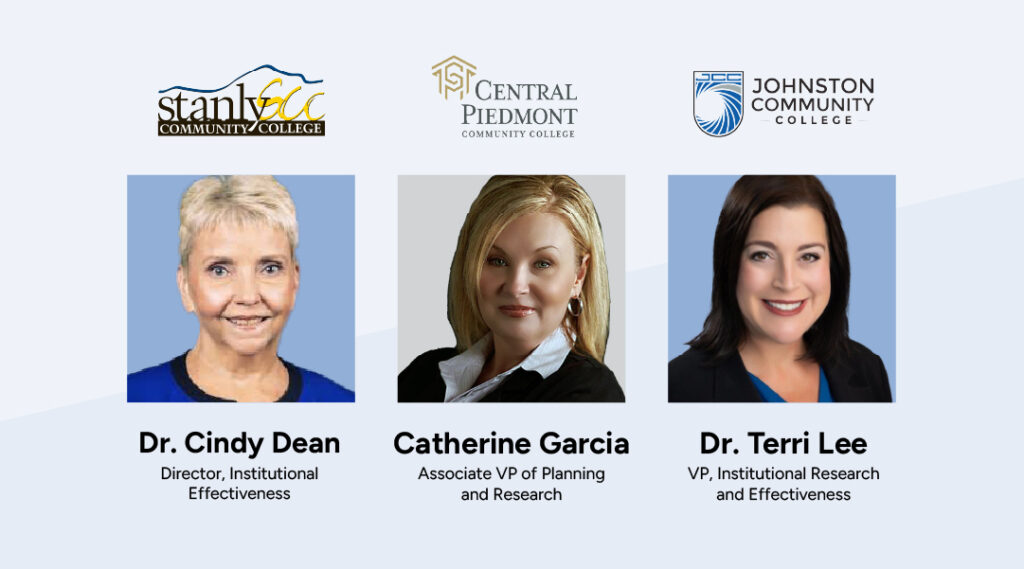
Watch an interactive panel discuss how their colleges are replacing manual data tasks with improved accessibility, empowering faculty and staff with actionable insights for strategic analysis and enhanced student success.

JCC’s move to a shared, up-to-date data foundation has strengthened both outcomes and execution. The benefits show up in measurable enrollment growth, stronger re-engagement of former students, and faster, more coordinated decisions that protect course access and student momentum.
Together, these benefits reflect a more responsive model at Johnston Community College – one where enrollment, scheduling, re-engagement, and student support decisions are coordinated early enough to matter. With shared visibility into pipeline movement, section demand, persistence patterns, and stop-out behavior, teams can adjust outreach and course offerings during the cycle, intervene sooner when students begin to slip, and bring former students back with clearer, timelier next steps. The result is not just stronger growth and re-enrollment outcomes, but fewer avoidable delays for students and more consistent follow-through that helps more learners persist and complete credentials aligned to long-term opportunity.